

Products


Dirk's Piano Tuner
Tuning a piano the classical way is a very complicated process. One has to possess the skills, to handle the tuning hammer in the correct manner and to leave the tuning pin in a
stable position. It is however even more difficult to determine the correct pitch of the strings.
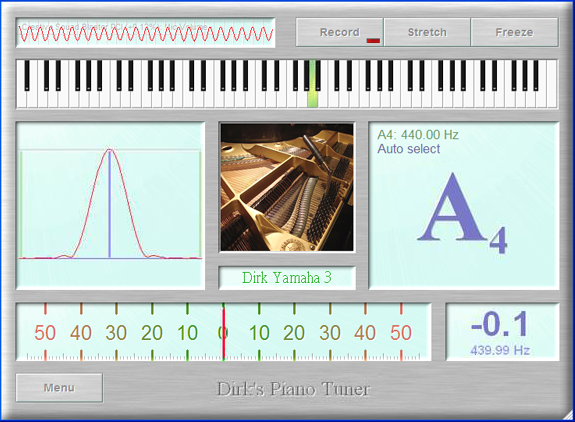 piano tuning, piano tuner
Many instruments can be tuned using a simple tuning device. Each tone is then tuned exactly to a predefined frequency. This method can't be used tuning a piano. The result would make the piano sound harsh and out of tune. The reason for this lies in the way stringed instruments produce their sound. Dirk's Piano Tuner analyzes your instrument and uses the results to calculate the optimal tuning for your piano in particular. Using this calculated setting, you can then tune your piano, in no time, to a professional level, without having to go through the classical, time consuming, process of 'checking the intervals'.
Many instruments can be tuned using a simple tuning device. Each tone is then tuned exactly to a predefined frequency. This method can't be used tuning a piano. The result would make the piano sound harsh and out of tune. The reason for this lies in the way stringed instruments produce their sound. Dirk's Piano Tuner analyzes your instrument and uses the results to calculate the optimal tuning for your piano in particular. Using this calculated setting, you can then tune your piano, in no time, to a professional level, without having to go through the classical, time consuming, process of 'checking the intervals'.




Compatibility
Microsoft

- Desktop
- Laptop
- Netbook
- Tablet
- Phone
- Pocket PC
- Windows 11
- Windows 10
- Windows 8.1
- Windows 8
- Windows 7
- Windows Vista
- Windows XP
- Windows ME
- Windows 2000
- Windows 98
- Windows Phone
- Windows RT
Apple

- iMac
- Mac Pro
- Mac mini
- MacBook
- Intel cpu
- M1 & M2 cpu
- iPad
- iPhone
- Sonoma
- Ventura
- Monterey
- Big Sur
- Catalina
- Mojave
- High Sierra
- Sierra
- El Capitan
- Yosemite
- Mavericks
- Mountain Lion
- Lion
- Snow Leopard
- Leopard
- Tiger
- iOS iPhone
- iOS iPad
The tuner is available in the following languages:


How to tune a piano
Tune a piano yourself to a professional standard
 How to tune a piano
An overview of this tuner's features
- Suitable for pianos and grand pianos of all brands and sizes.
- Realize a professional tuning easy and quick, exactly tailored for your particular piano.
- Calculates the most optimal stretch. Every string gets the optimal pitch.
- Save the calculated stretch so it does not need to be calculated again the next time.
- The A4 (default 440Hz) can be configured to any frequency you like.
- Very easy to use. No knowledge of the complicated piano tuning theory necessary.
- It is not needed to check intervals and to hear and count beats.
- Fast reaction of the needle to be able to tune to the right pitch easily.
- Automatic detection of the struck string prevents tuning the wrong string.
- Not only the tone is detected, but also its octave.
- The needle keeps tracking the tone, also if it moves into another tone.
- Take new strings up to the necessary tension, safe and quick.
Course 'Piano Tuning for beginners'
Course 'Piano Tuning for beginners'
During the course you will learn the theoretical and practical steps of the piano tuning process (with the help of Dirk's Piano Tuner).
During the course you will learn the theoretical and practical steps of the piano tuning process (with the help of Dirk's Piano Tuner).


Stretch
A string can vibrate in several ways. It can vibrate in one whole section; the middle of the string then oscillates and the
ends are fixed. It can vibrate in two sections; the middle and the ends are then fixed and the string oscillates on 1/4 and on 3/4 of the length.
This way a string can also vibrate in three, four, five or more sections.
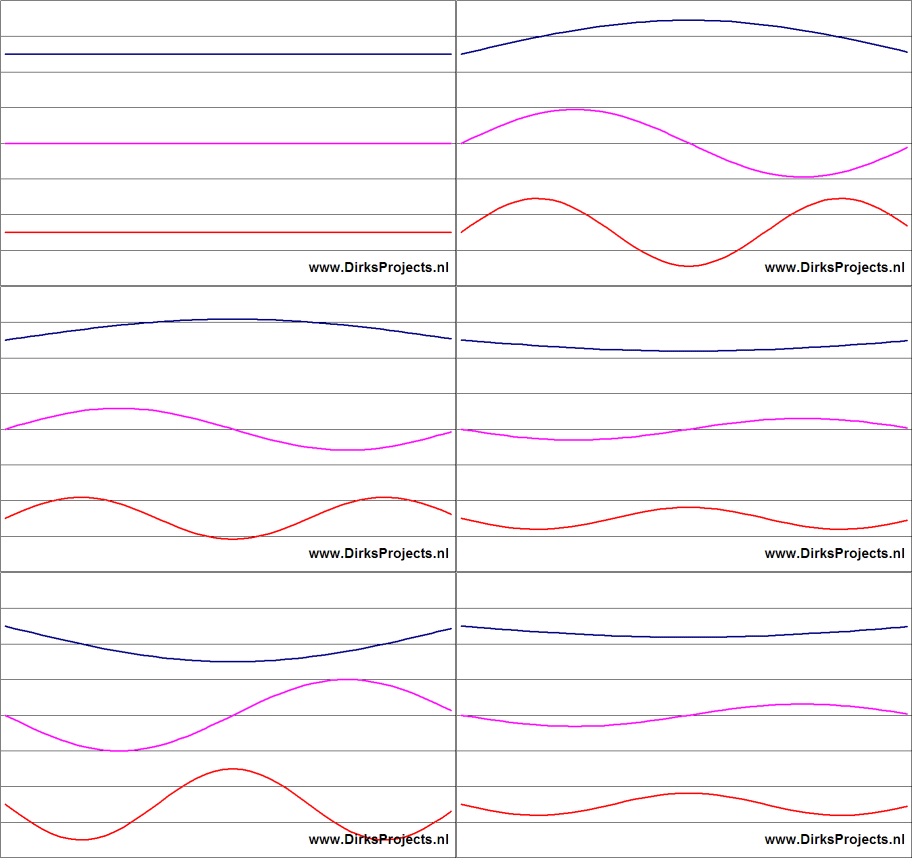 These are called the strings' harmonics
All these vibrations occur at the same time in the string. Each
vibration has its own frequency. A struck string therefore provides several frequencies at the same time. These are called the strings' harmonics.
When these harmonics are exactly 2, 3, 4 and 5 times the base frequency, then a simple tuning device can be used. For a piano this is
unfortunately not the case. For a piano these factors are not exactly 2, 3, 4, and 5. The exact values of these factors determine the base
frequencies of the piano strings, that is when the piano sounds most harmonic or 'in tune'. In practice it shows that the low note need to be
tuned a bit lower. The high tones need to be tuned a bit higher. The rate in which the low notes need to be tuned lower and the high notes higher
is called the stretch of the piano. This means that each piano has to be tuned differently to achieve its optimal sound and performance.
Determine the right stretch
There are already tuning devices that take this stretch into account. You can choose a stretch at setup, where a small stretch is
chosen for a large piano and a large stretch for a small piano. Such tunings devices can take the piano to an almost optimal tuning. But the specific
design of the concerning instrument is not taken into account and therefore some of the factors, that decide the stretch, are left out. Because of this,
the piano will not sound optimal and it will still be necessary to determine the best stretch 'by ear'.
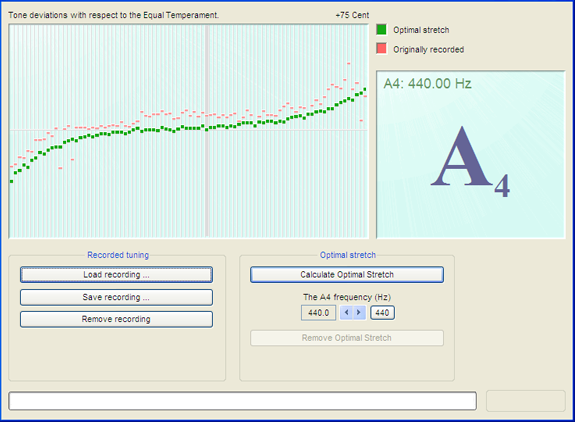 Automatically calculate the optimal stretch
The piano technician does this by striking a lot of intervals (two keys at the same time) and aligning them. To do this properly, a
lot of experience is an absolute necessity. The difficulty lies in the fact that you cannot tune the intervals entirely pure and the rate of purity is
different for each and every interval. When an interval is not entirely correct, one of both notes will be adjusted accordingly. This note however is
also part of several other intervals. Therefore all these intervals will have to change as well. All this produces a large complex puzzle that has to
be solved.
Dirk's Piano Tuner solves this puzzle for you. In Dirk's Piano Tuner all strings will be recorded by playing them all one by one, only one string per note the remaining strings muted. The tuning (and so is the stretch) is determined by the computer using these single string recordings. The tuner not only records the fundamentals, but also the harmonics. After this 'single string' recording, the tuner has all the data needed to calculate the optimum base setting of all strings. The tuner calculates then the purity of all possible intervals and aligns them. After this the strings can now be tuned one by one to the resulting notes from the tuner. The tuner recognizes the struck string automatically and shows how much the string deviates from its ideal pitch. The muted strings are lateron tuned equal to the earlier tuned string in the same unison. After tuning all strings the piano has been tuned with the best stretch. The piano now sounds as pure as possible for that particular piano. Each note needs only to be tuned once and it is no longer necessary to finish the tuning by ear.
Dirk's Piano Tuner solves this puzzle for you. In Dirk's Piano Tuner all strings will be recorded by playing them all one by one, only one string per note the remaining strings muted. The tuning (and so is the stretch) is determined by the computer using these single string recordings. The tuner not only records the fundamentals, but also the harmonics. After this 'single string' recording, the tuner has all the data needed to calculate the optimum base setting of all strings. The tuner calculates then the purity of all possible intervals and aligns them. After this the strings can now be tuned one by one to the resulting notes from the tuner. The tuner recognizes the struck string automatically and shows how much the string deviates from its ideal pitch. The muted strings are lateron tuned equal to the earlier tuned string in the same unison. After tuning all strings the piano has been tuned with the best stretch. The piano now sounds as pure as possible for that particular piano. Each note needs only to be tuned once and it is no longer necessary to finish the tuning by ear.

